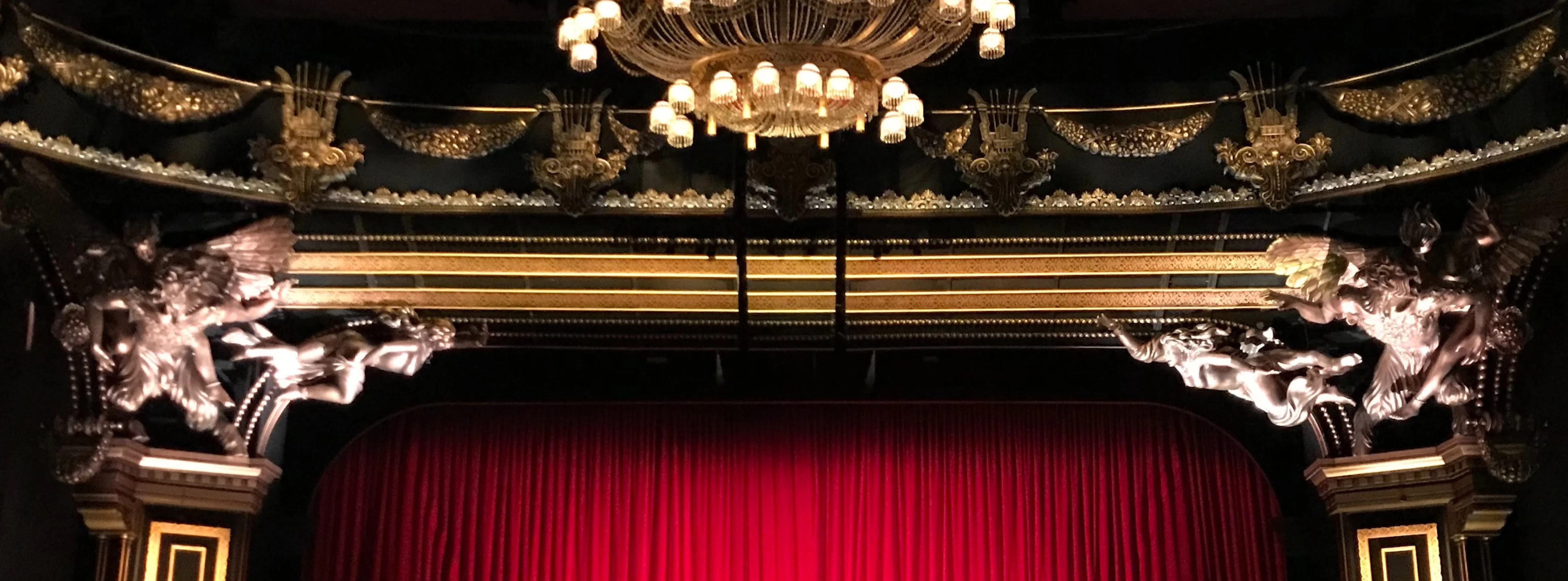
Booth Theatre
The Booth Theatre is a Broadway gem, designed by Henry B. Herts and opened in 1913. Named after the legendary actor Edwin Booth, the theater is known for its intimate atmosphere and elegant Beaux-Arts architecture. Over the years, it has hosted acclaimed productions and stars, making it a favorite for both classic and contemporary plays. The Booth’s timeless charm and rich history make it a fitting home for shows that demand a close connection between actors and audience. The Booth Theatre seating plan will help you find the best seats in the theater.

About Booth Theatre
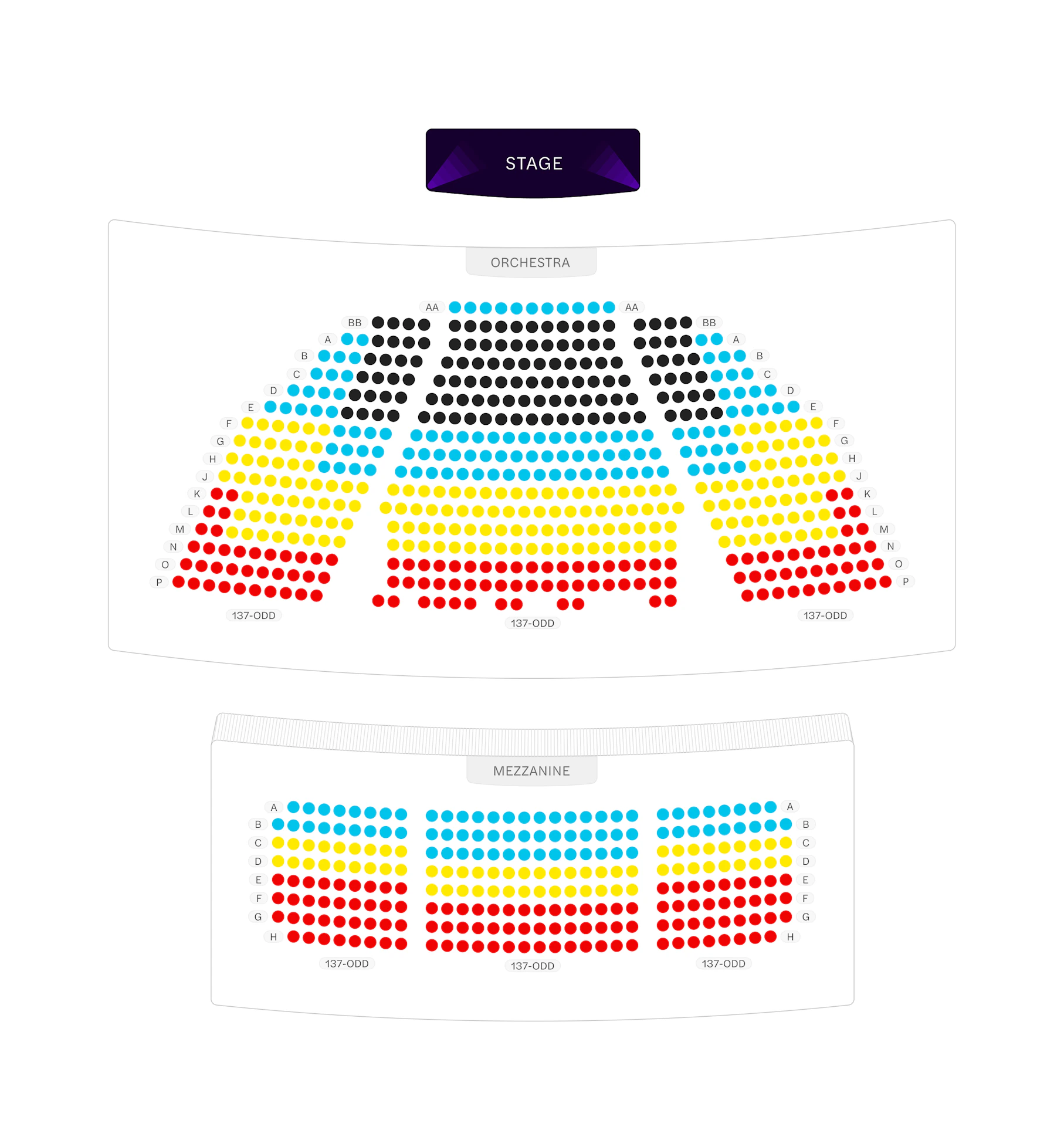
- The Booth Theatre has an approximate capacity of 766 seats, split across the Orchestra and Mezzanine levels and boxes along the sides. The capacity does not account for 22 standing-only spots and 30 removable seats in the Orchestra.
- Both levels are raked, sloping downward toward the Orchestra pit, which allows for decent views and clear sight lines across the venue.
- The wheelchair-accessible and companion seats are in the rear of the Orchestra. The Mezzanine is a balcony level that does not offer the same level of accessibility in seats. It can only be reached via stairs, which are equipped with handrails. Transfer seats are available on both levels.
- The theater has no escalators or elevators.
- Accessible step-free and street-level access is available to the lobby and Orchestra level from Shubert Alley. While both levels have entrances and promenades in the rear, the Mezzanine is not accessible to patrons with varying levels of mobility.
- The best seats in the house are in the Center Orchestra, closer to the front of the auditorium. For decent views at affordable rates, try the Middle Orchestra or the Middle Mezzanine.
- The cheapest seats are at the rear of both levels, though patrons might find these to offer less immersive experiences for some shows.
- The theater's smaller size and age lens itself to limited legroom, particularly in the Mezzanine section.
- Restrooms and water fountains are in the basement and on the Orchestra level. A wheelchair-accessible all-gender restroom is located on the Orchestra level.
- Concessions may be purchased on both levels.
Booth Theatre Seating Chart >
One of Broadway's oldest and most intimate theaters, Booth has built itself up to be a space for experimental shows that often do not get the limelight they deserve. Its showcases include off-kilter works like Butterflies Are Free and For Colored Girls Who Have Considered Suicide / When the Rainbow Is Enuf, demonstrating the theater's propensity for unusual and profound productions.
The theater might often be confused with the Booth's Theatre since both are named for the actor Edwin Booth. However, Booth's, which opened in 1869 and was constructed in a similar Italian style, was converted into a department store and eventually demolished in 1965. Booth, thankfully, has remained operational since 1913, staging a variety of prominent productions, its latest offering being the spunky musical comedy, Kimberly Akimbo.
- The Booth Theatre is constructed in the Italian Renaissance style, which draws on ancient Roman and Greek aesthetics.
- The theater's facade is a brock and terracotta structure, beautifully decorated with sgraffito carvings, arches, and curves. It includes the doors to the lobby and stage house, the latter of which is shared with the Shubert Theatre.
- The theater was constructed alongside the adjacent to Shubert Alley, which allowed for proper fire regulations to be met by way of a wide fire escape passage.
- The theater's auditorium and lobby feature a coved ceiling, wooden paneled windows, and a proscenium arch at the front. It additionally features molded doorways, cornices, brass lighting sconces, chandeliers, a coffered ceiling, as well as a Doric frieze and a bust of Edwin Booth.
- The original structure featured rich mulberry interiors as well as memorabilia of Booth, including his favorite armchair.
- Since Booth was designed to hose smaller, more intimate productions, it was built to look and feel as such. The facades, though stunning, eliminated the more common, often gaudy appearances of fellow playhouses. The theater's two lobbies acted as soundproofing to ensure a quieter experience indoors.
- The Great Adventure (1913)
- The Prince and the Pauper (1920)
- Hamlet (1925)
- Richard III (1949)
- Butterflies Are Free (1969)
- For Colored Girls Who Have Considered Suicide / When the Rainbow Is Enuf (1976)
- Bea Arthur on Broadway (2001)
- Who's Afraid of Virginia Woolf? (2012)
- Kimberly Akimbo (2022)
Know before you go
- Address: 222 W 45th St, New York, NY 10036, United States
- Bus: The nearest bus stop to the theater is on 8th Avenue and West 46th Street. The next closest stop is on 8th Avenue and West and 43rd Street. Both bus stops service lines M20 and M104.
- Subway: The closest subway stations to the Booth Theatre are along 42nd Street and service the A, C, E, 1, 2, 3, 7, N, Q, R, W, and S lines.
- Cars and cabs: Patrons may drive or take a taxi to the theater. The Broadway district gets quite crowded, particularly during peak seasons. Patrons may find themselves stuck in traffic or struggling to locate street-side parking during these times.
- Parking: There are multiple parking garages near Booth Theatre. These include Icon Parking, Icon Advance Parking, Times Square Parking, 1531 Broadway Garage, Meyers Parking, and more. Patrons may book themselves a spot via ParkWhix, SpotHero, or similar online services to avoid delays in finding a spot.
- Recommended mode of transport: We recommend using the subway for a quick, cost-efficient way to reach the Booth Theatre.
- Accessible entry: The lobby and Orchestra can be reached via street-level step-free entrances.
- Accessible seating: Accessible seating is located on both levels in the rear sections. The rest of the theater's seating areas are not wheelchair-accessible but still offer varying levels of accessibility including transfer seats and stairs with handrails.
- Restrooms: The restrooms are located in the lobby and on the Orchestra level. A wheelchair-accessible all-gender restroom is located on the Orchestra level.
- Hearing and visual assistance: The theater offers accommodations for patrons with hearing or sight loss.
- Concessions: The theater offers concessions for purchase on both levels.
- Accessible entrance: The Booth Theatre's Orchestra level and lobby are accessible via a street-level step-free entrance.
- Escalators and elevators: The Booth Theatre does not have any elevators or escalators.
- Wheelchair-accessible seats: The Orchestra has wheelchair-accessible and companion seats. Both levels have transfer seats. The Mezzanine is only accessible via stairs, which are equipped with handrails.
- Hearing and visual accessibility: Hearing and visual accommodations can be made for patrons, where required.
- Accessible and adapted restrooms: The wheelchair-accessible all-gender restroom is on the Orchestra level. The other restrooms are on the Orchestra level and in the lobby.
- Arrive early: We recommend arriving at least 45 minutes before your show to avoid delays when entering. While the theater is smaller and does not tend toward long wait times for entry, you might still need some time to park or walk to the theater, enter, and find your seats. Additionally, give yourself some time to grab concessions or visit the gift shop/
- Dress code: There is no dress code for the theater. Patrons are welcome to dress comfortably. Since most theaters are air-conditioned all year round, patrons are encouraged to bring a jacket or a sweater.
- Baggage: Since Booth is a smaller theater, they don't generally check large bags or coats. Smaller bags are permitted but might be subject to security screening.
- Food policy: No outside food or drink is permitted inside the Booth Theatre. Food and drink may be purchased from the theater's concession stands.
- Restrictions: Large recording equipment, noisemaking devices, flashlights and pointers, weapons and sharp objects, and any other equipment or device that could disrupt the show or bother fellow patrons are prohibited in the theater.
- Pets and service animals: Pets are not allowed at the Booth Theatre, but some service animals are permitted.
Grab a quick bite before your show at the Booth Theatre at one of many scrumptious eateries nearby.
- Playwright's Celtic Pub: A 4-floor Irish pub with a rooftop view of the city and the perfect drinks menu for a pre-show experience.
- Directions
- RA Sushi Bar Restaurant: Elegant and classic decor matched perfectly with delectable French cuisine.
- Directions
- Carmine's: A family-style restaurant offering gigantic portions of Italian classics.
- Directions
to Carmine's
- The Palm West Side: A pub-style restaurant in a club hub, this high-end steakhouse and winery is perfect for an evening of fine dining.
- Directions
- Blue Fin: Popular pre-theater restaurant and bar with a great view and a seafood and sushi menu.
- Directions to Blue Fin
Frequently asked questions about Booth Theatre
The venue is over 100 years old.
The theater was constructed in 1913.
The theater is named for the Shakespearean actor Edwin Booth. His notable performances included Hamlet, Richard III, and Iago. Sadly, his illustrious career is often overshadowed by his brother, John Wilkes Booth, whose claim to fame was his assassination of President Abraham Lincoln. But Edwin remains one of the most important and genre-defining figures in Shakespearean works, having set new standards for how these plays are acted, having played Hamlet more times than any other actor.
222 W 45th St, New York, NY 10036, United States.
The theater is accessible via car, taxi, subway, and bus. The nearest stops and stations are located within walking distance of the theater.
The theater is jointly owned by the Shubert Organization and Booth Theatre, LLC.
The theater has a capacity of 766 seats.
Patrons over the age of 4 are permitted at the theater. Each show also has its own age restriction and maturity rating. Patrons are advised to check in advance before booking their tickets.
The theater has wheelchair-accessible and companion seats, transfer seats, stairs equipped with handrails, an accessible restroom, and visual and hearing accommodations. A street-level step-free entrance leads to the Orchestra, where most of the accessible seating is located. Not all parts of the theater are accessible to patrons with mobility issues, particularly wheelchair users.
The theater stages smaller, more intimate productions due to its size. While it has had an illustrious run staging classic works, such as Shakespeare, it is also notable for putting on more niche productions such as Luv, Butterflies Are Free, For Colored Girls Who Have Considered Suicide / When the Rainbow Is Enuf, and The Elephant Man. Currently, it is playing Kimberly Akimbo.
Kimberly Akimbo opened off-Broadway at the Linda Gross Theater in 2021. The production, along with its cast, then moved to the Booth Theatre in 2022 where it has continued to run since. The show is set to close in April 2024.
The best views in the theater are the front rows of the Center Orchestra. The middle of the Center Orchestra and Center Mezzanine offers decent views at affordable rates. The rear of both sections tend to have the cheapest seats, though these may not always offer the best views.
There is no dress code for Broadway theaters but patrons are encouraged to dress comfortably and appropriately.
Ticket prices vary based on the show date and timing, season, seating preferences, and more. Tickets for Kimberly Akimbo currently start at $78.40.
The theater sells a limited menu at concession stands located on both floors. No outside food or drink is permitted inside the theater.
Patrons may have their pick from a variety of nearby eateries. For pub grub, steaks, quick meals, and more, try Playwright's Celtic Pub or The Palm West Side. For cuisine-based dining, try Asian meals at RA Sushi Bar Restaurant or Blue Fin or Italian food at Carmine's.
There is plenty to do around the Booth Theatre. If you've got time to spare, you could try experiences like escape rooms, bowling, jazz clubs, and much more. For a quintessential NYC experience, try Madame Tussaud's Wax Museum and Times Square. For theater aficionados, try the Museum of Broadway. Don't forget to visit the Booth Theatre shop on your way out.
