
Skip to main content‌

The Ambassador Theatre opened in 1921, designed by architect Herbert J. Krapp for the Shubert Organization. Its distinctive diagonal auditorium layout, created to make best use of a narrow Midtown lot, gives nearly every seat a clear view of the stage. Over the decades, it has hosted landmark productions such as Godspell (1977), Dreamgirls (1987) and Bring in ’da Noise, Bring in ’da Funk (1996). Since January 2003, it has been home to the current production of Chicago. The Ambassador Theatre seating chart will help you find the best seats in the theater.

Vertical Product Card Shimmer

About Ambassador Theatre

  • The Ambassador Theatre, boasting a seating capacity of 1093, allocates 584 seats to the Orchestra, 264 to the Front Mezzanine, and 245 to the Rear Mezzanine. In the Orchestra section, divided into left, center, and right subsections, the center offers prime views, particularly in the front rows (AA-B) and middle seats (105-109). Pricing mirrors the view quality, with front-row seats being the priceiest and the last row the most economical. The left and right Orchestra sections are similar in viewing angles, with closer seats to the center being preferable.
  • The Front Mezzanine, with 264 seats divided into left and right subsections, provides a consistently good view, especially in the first few rows. The last few rows may be skipped for those on a budget. Opting for corner Front Mezzanine seats over corner Orchestra seats can be a wallet-friendly choice for Chicago The Musical.
  • The Rear Mezzanine, the smallest section, is divided into four subsections. Most seats, excluding the first few rows, offer an average view, explaining their relatively lower prices. For those on a tight budget or less concerned about stage views, any seat in the Mezzanine or the standing-row seating section is a viable option.
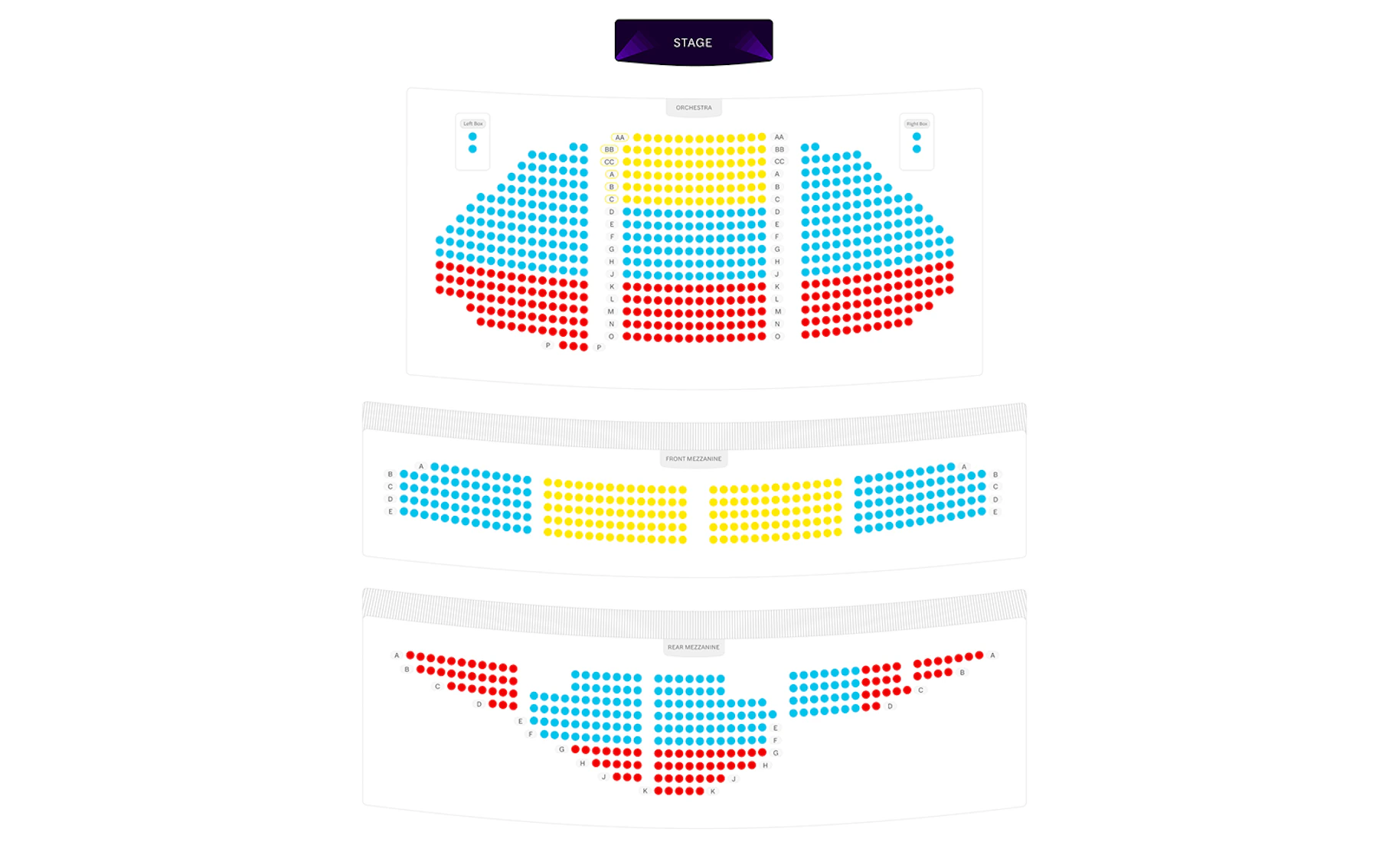
seatmap

Times Square emerged as the hub for large-scale theater productions between 1900 and the Great Depression, with many theaters developed by the Shubert brothers in Midtown Manhattan during the 1900s and 1910s. The Shuberts, originating from Syracuse, New York, controlled a significant portion of plays and ticket sales in the U.S. by 1925. The Ambassador Theatre, part of their plan for six theaters, opened in 1921. Initially hosting operettas, it faced successes and flops in the 1920s.

In the late 1930s, it shifted to drama, and in 1938, it was leased to CBS as a broadcasting studio. The Ambassador underwent various uses, including films and opera, until its revival as a legitimate theater in 1956. Productions over the years ranged from plays to musicals, and in the 1980s, the Shuberts renovated it. Designated a landmark in 1985, the Ambassador has seen diverse productions, with "Chicago" becoming a long-standing success since 2003, interrupted only briefly by the COVID-19 pandemic in 2020 before reopening in 2021.

  • Herbert Krapp was responsible for the interior design of the Ambassador, incorporating intricate Adam-style decoration on the walls, ceiling, boxes, doorways, and arches—design themes known to be his favorites.
  • The theater, constructed on a compact lot, had the unique challenge of a diagonal layout for the auditorium, resulting in a distinctive hexagonal shape. This architectural choice also made the stage notably wide but led to a limitation in wing space.
  • With a total of 1088 seats, the Ambassador Theatre is divided into three main sections: orchestra, front mezzanine, and rear mezzanine.
  • Additionally, there are limited seats available in the pit, along with some standing-row options. Each seat offers a unique viewing angle, and pricing varies based on the quality of the view provided.
  • Dreamgirls (1987)
  • Fool Moon (1995)
  • Bring in 'da Noise, Bring in 'da Funk (1996)
  • You're a Good Man, Charlie Brown (1999)
  • Chicago (2003)

Know before you go

  • Address:  219 W 49th St, New York, NY 10019, United States
  • Subway: For those utilizing the subway, the nearest station to the Ambassador Theatre is 49th Street, served by lines such as N, R, and W. The theater is a one-minute walk from this subway station.
  • Bus: Various bus options are available for those opting for public transportation. Buses, including the M7, M20, and M104, stop a short walk away at West 50th Street and 7th Avenue. Once disembarking from the bus, it's a convenient two-minute stroll to the theater via 7th Avenue.
  • Restroom: For patrons requiring wheelchair accessibility, there is a designated restroom available at this theater.
  • Elevators and Escalators: Please note that this theater does not feature elevators or escalators for vertical transportation.
  • Water Fountain: Stay refreshed with water fountains conveniently located in both the ticket lobby and on the mezzanine level.
  • Hearing Assistance: Assisted Listening Devices are offered for patrons in need. To reserve one, a deposit in the form of a Drivers License/ID with an address is required.
  • Arrive Early: We recommend arriving at least 20 minutes before your show to avoid delays getting in.
  • Food Policy: No outside food or drink is permitted inside the theater. Refreshments and snacks are available at the theater's in-house bar.
  • Dress Code: There is no set dress code for the Ambassador Theatre, and patrons are encouraged to dress comfortably so they can relax and enjoy their experience.
  • Baggage: Large bags may not be taken inside the theater and must be checked at the coatroom. Smaller bags are permitted but might be subjected to screening and security checks.
  • Restrictions: No recording equipment is permitted inside the theater. Additionally, noisemaking devices, flashlights, pointers, and any other equipment that could disrupt the show or cause a disturbance to fellow patrons are prohibited. They may be checked in at the cloakroom before entering.
  • Pets and Service Animals: Pets are not permitted entry into the theater. Special accommodation can be made for service animals, with prior notice.
  • Planet Hollywood: Indulge in Hollywood memorabilia and classic American cuisine at 1540 Broadway.

​Directions to Planet Hollywood.

  • Ellen’s Stardust Diner: Experience a '50s-themed diner with singing servers and a diverse menu of American classics at Ellen’s Stardust Diner.

​Directions to Ellen’s Stardust Diner.

  • Orso: Situated at 322 West 46th Street, Orso is a revered theater district establishment offering gourmet Tuscan cuisine with flair.

​Directions to Orso.

  • Toloache: Immerse yourself in a festive atmosphere while savoring modern Mexican dishes enriched with tradition at Toloache.

​Directions to Toloache.

  • Trattoria Trecolori: For the city's finest Italian food served in a straightforward, no-fuss manner, head to Trattoria Trecolori. This joint prioritizes the quality of its food above all else.

​Directions to Trattoria Trecolori.

Frequently asked questions about Ambassador Theatre

The venue is over 100 years old, having opened its doors in 1921.