Gershwin Theatre
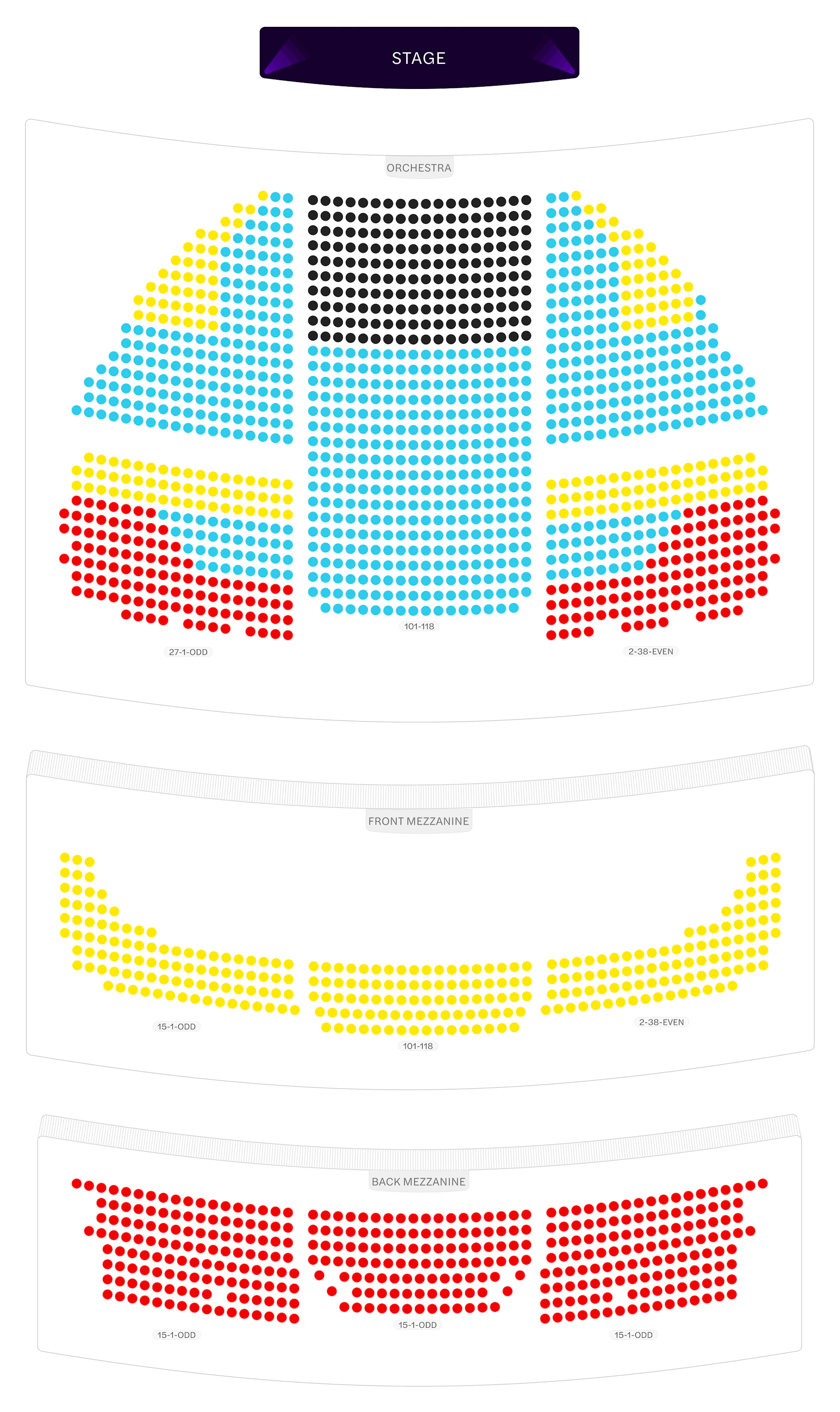
The Gershwin Theatre was designed by architect Ralph Alswang and opened in 1972 (initially as the Uris Theatre). With its Art Nouveau‐inspired entrance rotunda and the display of the American Theatre Hall of Fame in its lobby, the space blends grand theatrical presence with refined design. Over the years, it has hosted landmark shows such as The King and I (1977), Sweeney Todd (1979), Singin’ in the Rain (1985) and a revival of Show Boat (1994), among many others. The Gershwin Theatre seating chart will help you find the best seats in the theater.

About Gerswhin Theatre
- The Gershwin Theatre has a capacity of over 1,900 split across two sections. Most of its seating is in the Orchestra, while the Mezzanine houses over 600 seats.
- The middle front seats of the Center Orchestra are premium seats that offer an unobstructed view of the stage. The Center Mezzanine also offers stunning views, giving you a clearer view of larger dance numbers, such as those in Wicked.
- Seats toward the rear of both sections and toward the ends of rows tend to be priced better but have restricted sight lines. The corner seats offer the best legroom.
- Designated wheelchair-accessible and companion seating are available in both sections and are accessible via elevators and escalators. The front of the Orchestra is not accessible via elevators or escalators.
- The main lobby elevator is strictly designated for guests with disabilities. In addition to access to designated seating, this elevator can also be used to reach the wheelchair-accessible restroom on the second floor and the fourth-floor Mezzanine restrooms which have wide stalls and are accessible without steps.
- Water fountains are present in the Rear Orchestra and Front Mezzanine.
The Uris Theatre opened in 1972 with a production of the space musical Via Galactica. The theater was the first new legitimate theater on Broadway in nearly 50 years and would go on to stage musicals, concerts, ballets, plays, and much more throughout its history. While the original theater earned its name from the Uris Buildings Corporation, it was renamed in honor of the Gershwin brothers in 1983 at the 37th Tony Awards.
Despite initially being hailed as a "leader in the revitalization of Broadway," the theater saw its fair share of struggles before eventually finding some success in the staging of concerts. Musicians like Sammy Davis Jr., Frank Sinatra, Ella Fitzgerald and more graced its stage, and the theater's musical leanings extended to include The Grammys, the opera Treemonisha, and performances from the American Ballet Theatre. It has since staged notable productions like Singin' in the Rain, Meet Me in St. Louis, Fiddler on the Roof, Camelot, and most recently, Wicked.
- The Gershwin was designed by Ralph Alswang, a theater and film director, producer, and designer, who notably designed scenery, lighting, and costumes for close to 100 Broadway productions.
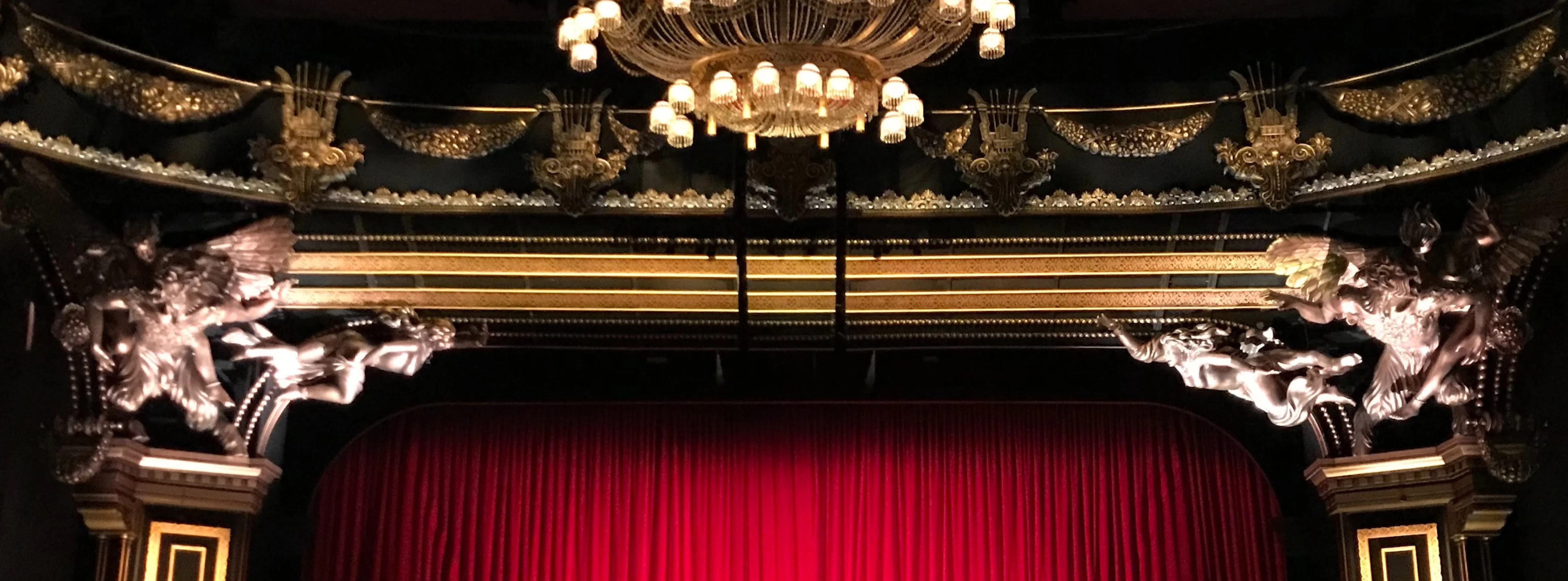
- The theater was designed to be modern and naturalistic, mostly in the Art Nouveau style, as Alswang did not want it to distract from the show. As such, it was crafted with a focus on sight lines and acoustics, though that did not mean it lacked the grandeur of its predecessors entirely.
- The public spaces are covered in plush bronze velour. While the original space was white and gold, the redecorated theater now houses a white and blue color scheme instead.
- The auditorium is occupied by a larger Orchestra, as Alswang noted that most patrons prefer orchestra seating. The design also retained the older idea of placing aisles in the center and along the sides, while increasing the spacing between seats to create a more comfortable experience.
- The Gershwin is also designed to be modular in some regards: its arch includes detachable light bars while some of the wall panels can be removed if more speakers are required. The stage can be disassembled or extended forward.
- The Gershwin is the first commercial theater in the U.S. to be fully automated, having foregone fire curtains for a computerized sprinkler system.
- The theater sits within the Paramount Plaza and is home to the American Theater Hall of Fame on its second floor. The Hall features the names of notable personalities from the world of theater inscribed in gold.
- Sammy Davis Jr. (1974)
- Sweeney Todd: The Demon Barber of Fleet Street (1979)
- Singin' in the Rain (1985)
- Fiddler on the Roof (1990)
- Yanni (1993)
- On the Town (1998)
- Wicked (2003)
Know before you go
- Address: 222 W 51st St, New York, NY 10019, United States
- Bus: Bus lines M50, M20, M104, BXM2, M7, M11, and more all go by the Gershwin Theatre. The nearest bus stop to the theater is the New York, NY 850 8th Avenue. It is on the northeast corner of 51st Street, in front of the Dunkin Donuts store, and is a 2-minute walk from the theater entrance.
- Subway: To get to the Gershwin Theatre by subway, ride the B, D, F, or M trains to 42nd Street and 8th Avenue, the 1 or 9 trains to 42nd Street and Broadway, or take the N, Q, R, or W trains to 42nd Street and 7th Avenue. The nearest station is the 50th Street Station, located on the corner of West 50 Street and 8th Avenue.
- Cars and cabs: Cabs can take you directly to the theater from any part of New York and are an easy way to get there, albeit more costly than the other options. Patrons may choose to drive there themselves, in which case they may make use of one of the nearby parking garages. We recommend arriving at least 40 minutes before your show’s start time to avoid delays getting in.
- Parking: Times Square is home to plenty of parking garages. The ABM Parking Services lot, located adjacent to the Gershwin, offers discounted rates for Wicked patrons who arrive with a printed discount coupon. Icon Parking also has multiple lots within walking distance of the theater. Patrons may use the ParkWhiz app to stay updated on show-day prices, as these may vary day-to-day.
- Recommended mode of transport: We recommend using the subway for an easy, cost-efficient, and delay-free way to reach the Gershwin Theatre.
- Restrooms: Women's and Men's restrooms are available on the Mezzanine floor and feature wide stalls. An accessible restroom is available on the second floor.
- Water fountain: Water fountains are located in the areas at the Rear Orchestra and Front Mezzanine.
- Accessible seating: Designated wheelchair-accessible and companion seats are located in the Rear Orchestra and Mezzanine sections. Transfer seats are located along the Orchestra aisles but most are only accessible via steps.
- Hearing and visual assistance: A variety of hearing and visual assistance services and devices are available for free or for rent on the second floor of the theater.
- Concessions: The Gershwin bars start serving patrons 45 minutes before the show and during intermissions. The menu includes alcoholic and nonalcoholic beverages as well as snacks.
- Accessible entrance: The Gershwin Theatre can be accessed via a strep-free, street-level entrance on the arcade between 50th and 52nd streets.
- Wheelchair-accessible seats: The Rear Orchestra and Mezzanine both have wheelchair-accessible and companion seating. Both areas are accessible via elevators or escalators. The main lobby has an elevator strictly for patrons with disabilities.
- Accessible seating: Transfer seats are available along the aisles, but many are only accessible via steps. The seats in row E of the Mezzanine level are step-free.
- Accessible and adapted restrooms: The wheelchair-accessible restroom is on the second floor. The remaining restrooms, though not fully adapted, still offer some level of accessibility. The fourth-floor Mezzanine restrooms have wide stalls and offer step-free access.
- Hearing assistance: Assistive listening headsets, on-demand closed caption devices and apps, induction loop systems, ASL-interpreted performances, and more are available at the Gershwin Theatre. Patrons may collect their devices free of charge on the second level of the theater. Rentals are also available from the bar on the same level.
- Visual assistance: Audio descriptions are available for patrons who are blind or visually impaired.
- Service animals: Guide dogs and service animals are allowed at the Gershwin Theatre. Patrons are encouraged to contact the theater or speak to the ticket sales representatives if they require any accommodations.
- Arrive Early: We recommend arriving at least an hour before your show to avoid delays when entering.
- Dress Code: There is no set dress code for the Gershwin Theatre. Patrons are encouraged to dress comfortably, though it is expected they are attired appropriately. The theater is air-conditioned during summer months, so patrons are requested to bring a sweater along if required.
- Age restrictions: The Gershwin only allows patrons aged 5 and above entry.
- Baggage: The coat check is near the back of the theater lobby. All bags are subjected to security screening. The Gershwin only permits bags small enough to comfortably fit with you at your seat, whether you plan to take it with you or check it at the lobby. Patrons are advised to not bring large bags, including shopping bags and luggage, with them. Coat check services are available during winter months.
- Food Policy: No outside food or drink is permitted inside the Gershwin Theatre. Bottled water and drinks with secured lids are allowed inside. Patrons who have medical requirements are allowed to bring specific food and drink inside with them. The theater has two bars on the second floor and two on the fourth which serve alcoholic and nonalcoholic drinks and snacks. The bars begin serving patrons 45 minutes before shows and during intermissions.
- Restrictions: Large professional recording equipment, noisemaking devices, flashlights, pointers, and any other equipment that could disrupt the show or cause a disturbance to fellow patrons are prohibited and will be confiscated during security screening. Weapons of any kind, including sharp objects like knives or scissors, mace or pepper spray, firearms, and tasers are strictly prohibited. The management reserves the right to confiscate any items deemed dangerous or inappropriate during screening.
- Pets and Service Animals: The Gershwin Theatre welcomes guide dogs and service animals. Patrons are encouraged to inform theater staff in advance if they have any additional requirements.
The Gershwin Theatre is surrounded by delectable eateries that offer a variety of cuisines to suit every palate. Here are a few of our favorites to get you started:
- McHale's Pub & Grill: There's always something happening at this pub grub haunt that features over 15 flat-screen TVs and spirited games of darts.
- Directions
- Toloache: A blend of modern and traditional Mexican cuisine, this festive restaurant serves everything from chips and guacamole to its dishes that are uniquely Toloache.
- Directions
- Gallaghers Steakhouse: A Times Square fixture since 1927, Gallaghers is especially known for its classic cuts and raw bar items.
- Directions
- Times Square Diner & Grill: A wonderfully American experience awaits at this stylish, modern diner and bar with loft-height ceilings.
- Directions
- Churrascaria Plataforma: A Rodízio-style Brazilian restaurant, Churrascaria is as impressive with its menu as it is with its performance.
- Directions to Churrascaria Plataforma
Frequently asked questions about Gerswhin Theatre
The Gershwin Theatre, with over 1,900 seats, is the largest theater on Broadway.
The venue is over 50 years old. Originally the Uris, it was renamed the Gershwin Theatre in 1983.
The theater was constructed in 1972.
The Uris Buildings Corporation constructed the theater in their name originally. In 1983, it was renamed at the 37th Tony Awards in honor of the musical-writing brothers Ira and George Gershwin, whose contributions to the world of music and theater could never be overstated. George sadly passed away in 1937, long before his time. Ira's death came in 1983, just two months after the Gershwin Theatre was renamed in the brothers' honor. The theater now stands as a monument both to the art of theater and the art of musical composition.
222 W 51st St, New York, NY 10019, United States.
The theater is accessible via subway and bus, with both stands located within walking distance. Patrons may also reach the theater via car or taxi.
The theater is owned and operated by the Nederlander Organization.
The theater has a capacity of nearly 2,000 with seats split across two sections. Its capacity has continued to grow over the years and it now stands as the largest theater on Broadway.
Patrons aged 5 and above are permitted entry into the theater. Children under 5 are not allowed out of respect to the other patrons.
Yes, the theater offers designated and accessible seating for patrons with varying levels of mobility. It also provides assistive devices and tools for vision and hearing needs. An accessible restroom is located on the second floor, while the restrooms on the fourth are adapted to some extent.
The theater has staged a variety of productions in its time. This includes concerts from Sammy Davis Jr., Frank Sinatra, Ella Fitzgerald, Count Basie, and Yanni, musicals such as Gigi, Mame, Singin' in the Rain, and Show Boat, and plays like Much Ado About Nothing. Its current show is Wicked, which has run at the theater since 2003.
The original production of Wicked, starring Idina Menzel and Kristen Chenoweth, premiered on Broadway at the Gershwin Theatre in 2003. The multi-award-winning musical is Broadway's fourth-longest-running show.
There is no dress code for this theater. Patrons are nonetheless encouraged to dress comfortably and appropriately, refraining from wearing outfits that might be inflammatory, such as any that feature hate language or imagery. The theater is air-conditioned in summer months and patrons might consider bringing a sweater along.
Ticket prices vary based on the show, date, timing, seating, season, and more. Tickets for Wicked start at $96.50.
The best views in the house are in the Center Orchestra. The front and center seats of the Mezzanine offer similar views albeit at a slight distance. This might limit your ability to see expressions more clearly, but gives you a clearer view of the ensemble numbers. Seats at the ends of the rows in the corners tend to have restricted sight lines but offer more legroom.
The theater serves beverages and snacks including soft drinks, alcoholic drinks, cocktails, water, candy, and more at its four bars located on both its floors. They start serving patrons 45 minutes before shows start and during intermissions. Patrons may pre-order drinks for their intermission before their show starts.
There are plenty of good options if you're looking for a quick bite or a meal near the theater. McHale's Pub & Grill is a relaxed sports bar where you can grab a drink and some pub grub before your show. For cuisine-specific eateries, try the Mexican menu at Toloache or the Brazilian menu at Churrascaria Plataforma.
Located inside Paramount Plaza, the Gershwin sits nestled between Broadway theaters all playing the most lauded modern productions. Just beyond them, however, are sights that include the Rockefeller, Birdland Jazz Club, Times Square, and experiences ranging from escape rooms to bookstores and observation decks overlooking the city. Additionally, if you're into theater history and architecture, the Times Square Church is an interesting spot that was previously the Mark Hellinger Theatre. Out of respect for the landmark, the Church opted not to alter it and conducted its services in the former venue's stunning interiors.