Closing Date
Until April 29, 2026

Age limit
Suitable for all ages
Why Watch Innocence?
- Kaija Saariaho’s opera Innocence in New York uses mixed vocal styles and a layered structure to examine how violence reshapes families and communities.
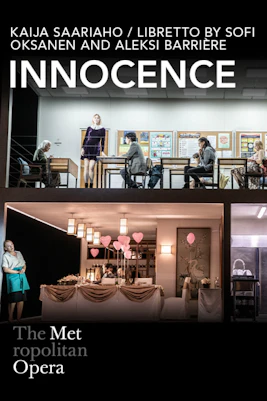
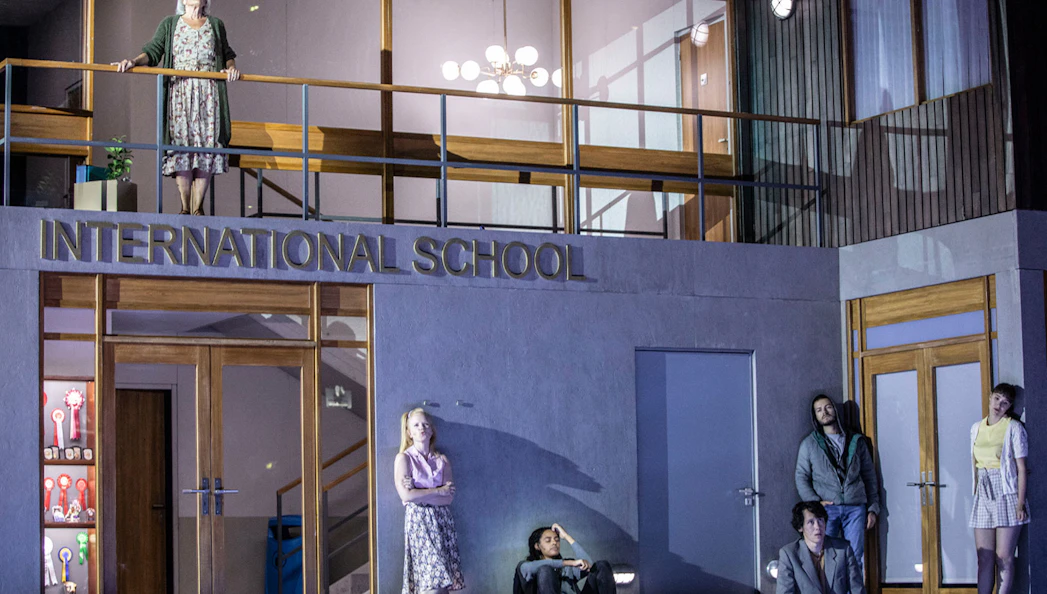
- Director Simon Stone stages the opera with cinematic precision, supported by Chloe Lamford’s revolving set and Timo Kurkikangas’s immersive sound design.
- Joyce DiDonato, Jacquelyn Stucker, Miles Mykkanen, and Vilma Jää anchor the ensemble, conducted by Susanna Mälkki, a longtime Saariaho collaborator.
- This Met premiere brings a "completely exhilarating" (The New York) experience. Book Innocence opera tickets now for this limited run.
Innocence in New York is Kaija Saariaho’s final opera, written with librettist Sofi Oksanen and dramaturg Aleksi Barrière. Its narrative spans two timelines connected by the aftermath of a school shooting. Saariaho’s music blends operatic writing with folk influences, speech-based rhythms, and atmospheric textures that mirror fractured memory. Stone’s production uses shifting rooms and fluid staging to reveal characters’ perspectives, allowing the story to unfold like a recollection rather than a chronology. The result is a work that examines silence, responsibility, and the long reach of unresolved trauma. The opera’s multilingual libretto reinforces its fragmented emotional landscape, aligning text and music with lived experience rather than linear storytelling.
Storyline
A wedding celebration unravels when a buried secret resurfaces: the groom’s family was tied to a school shooting ten years earlier. As survivors and relatives confront one another, memories collide with the present. The opera moves between the day of the tragedy and the wedding, revealing how grief, guilt, and denial shaped each life. Through intersecting testimonies, Innocence asks whether forgiveness is possible and whether truth can ever repair what violence has broken.
Show timings
Show timings for Innocence may vary every week. You can check the show timings for your preferred date at the next stage of booking.
Cast & Crew
Leading roles: Jacquelyn Stucker as the Bride, Miles Mykkanen as the Bridegroom, Joyce DiDonato as the Waitress, Kathleen Kim as the Mother-in-Law, Rod Gilfry as the Father-in-Law, Stephen Milling as the Priest, Lucy Shelton as the Teacher, Vilma Jää as Markéta, Beate Mordal as Lily, Julie Hega as Iris, Simon Kluth as Anton, Camilo Delgado Díaz as Jerónimo, and Marina Dumont Anastassiadou as Alexia
Conductor: Susanna Mälkki
Composer: Kaija Saariaho
Librettists: Sofi Oksanen, Aleksi Barrière
Director: Simon Stone
Set designer: Chloe Lamford
Costume designer: Mel Page
Lighting designer: James Farncombe
Sound designer: Timo Kurkikangas
Choreographer: Arco Renz
Chorus director: Tilman Michael
Age Suitability
This show is suitable for all ages.
Age suitability recommendations are just suggestions. So, trust your judgment when booking tickets for any show, and enjoy!
Security: To ensure your comfort and security, you might encounter a few security checks when you arrive at the venue.
Dress code: Smart casual or semi-formal attire is the way to go.
Outside food: While outside food isn't usually allowed, many theaters have cafes or restaurants nearby for you to check out before or after the show
Metropolitan Opera House
The Metropolitan Opera House, located in the Lincoln Center for the Performing Arts on Broadway, is home to the Metropolitan Opera and has been since it opened in 1966. The theatre, designed by Wallace Harrison, is one of the world's largest opera houses with a seating capacity of 3800. The Metropolitan Opera House is renowned for its technologically advanced stage facilities, its excellent acoustics, and the grandeur of its auditorium and front-of-house spaces. Seating Capacity: 3800 Metropolitan Opera House Seating Plan will help you find the best seats in the theatre.
Getting There
- Address: 30 Lincoln Center Plaza, New York, NY 10023, USA
- By metro:
Take the No. 1 train to 66th Street Lincoln Center station
- By train:
The Nearest station to the venue is 66th Street–Lincoln Center (1 train). The venue is just a 3‑minute walk from the station.
- By bus:
Buses M5, M7, M10, M11, M20, M66, M104 and BxM2 stop at the Metropolitan Opera House
- By car:
Patrons can drive or take a taxi to reach the Met.
Facilities & Accessibility
Amenities: Dining outlets, Cloak room, Toilets, Souvenir shop, Free parking, Wifi
Accessibility: Wheelchair accessible, Service animals allowed, Elevator access
Additional Information
- Security: To ensure your comfort and security, you might encounter a few security checks when you arrive at the venue.
- Dress code: Smart casual or semi-formal attire is the way to go.
- Outside food: While outside food isn't usually allowed, many theaters have cafes or restaurants nearby for you to check out before or after the show.
Tickets Redemption
</ul>
Cancellation & Refunds
- These tickets can't be cancelled or rescheduled.

Frequently asked questions
The opera does not have a strict age limit. It is suitable for all ages.
The show is playing at he Metropolitan Opera House in New York.
It follows two timelines linked by a school shooting, revealing how families, survivors, and witnesses carry long-term emotional fallout.
The running time is 1 hour 50 minutes with no intermission(s).
The main stars of the show are Jacquelyn Stucker as the Bride, Miles Mykkanen as the Bridegroom, Joyce DiDonato as the Waitress, Kathleen Kim as the Mother-in-Law, Rod Gilfry as the Father-in-Law, Stephen Milling as the Priest, Lucy Shelton as the Teacher, Vilma Jää as Markéta, Beate Mordal as Lily, Julie Hega as Iris, Simon Kluth as Anton, Camilo Delgado Díaz as Jerónimo, and Marina Dumont Anastassiadou as Alexia.
No. It uses multiple languages to reflect the cultural diversity of the characters. Met Titles are offered in English, Spanish, and German.
The score blends traditional operatic writing with spoken rhythms, folk influences, and atmospheric orchestral textures.
Yes. This staging marks its Metropolitan Opera premiere.
Yes, though the subject matter is intense. Its structure and staging offer clear storytelling for first-time opera audiences.
Trauma, guilt, accountability, family dynamics, collective memory, and the impact of silence.