Duration
3 hrs with 1 interval
Closing Date
Until June 6, 2026

Age limit
Suitable for all ages
Why Watch La Traviata?
- One of the most frequently performed operas worldwide, Verdi’s intimate tragedy centers on a heroine rarely granted dignity on the 19th-century stage.
- The role of Violetta Valéry is considered a pinnacle of the soprano repertoire, here shared by Lisette Oropesa, Rosa Feola, and Ermonela Jaho, each known for distinct vocal interpretations.
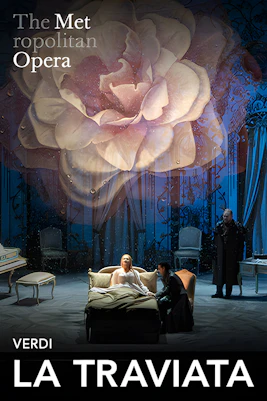
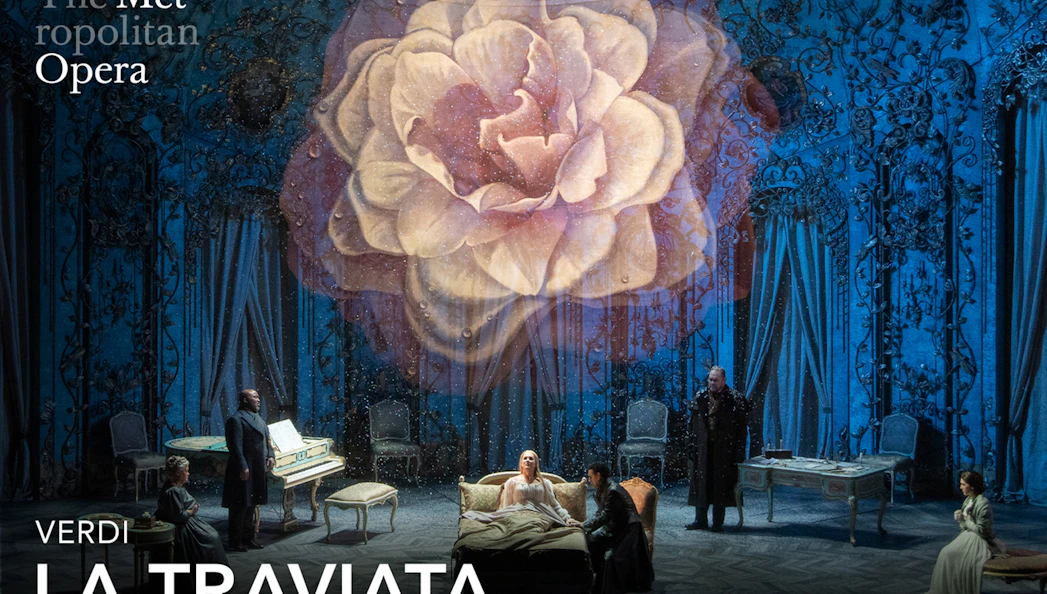
- Michael Mayer’s production places the story in a lyrical, dreamlike world that supports the score’s emotional shifts without overwhelming it.
- Verdi’s music moves between social spectacle and private devastation, from Act I’s glittering salon scenes to the stripped-back heartbreak of the final act.
- Presented by the Met, this repertory staple offers multiple casting combinations across the season, making each performance subtly different. Book your tickets to the La Traviata opera!
First premiered in 1853, La Traviata marked a departure for Giuseppe Verdi, who set the opera in contemporary society rather than historical legend. Based on Alexandre Dumas fils’ La Dame aux Camélias, the work focuses on a woman judged by society yet capable of profound sacrifice and love. This Metropolitan Opera revival, directed by Michael Mayer, balances visual poetry with narrative clarity. The production’s design by Christine Jones and costumes by Susan Hilferty frame the drama without distancing it from its emotional core. Sung in Italian with multilingual titles, La Traviata opera remains a defining work of both Verdi’s career and the operatic canon.
Storyline
Parisian courtesan Violetta Valéry finds unexpected love with Alfredo Germont, who offers her a life beyond society’s judgments. Their fragile happiness is challenged by social pressure, family obligation, and Violetta’s declining health. As personal sacrifice collides with public morality, Violetta must choose between love and survival in a world that allows her little space for either. Whether redemption arrives too late remains the opera’s enduring question.
Show timings
Show timings for La Traviata may vary every week. You can check the show timings for your preferred date at the next stage of booking.
Cast & Crew
Leading roles:
Lisette Oropesa as Violetta Valéry (March 20–31, April 4, April 7, April 10)
Amanda Woodbury as Violetta Valéry (April 3)
Rosa Feola as Violetta Valéry (May 3–June 6)
Ermonela Jaho as Violetta Valéry (May 6–16)
Piotr Buszewski as Alfredo Germont (March 20–31, April 4, April 10)
Arturo Chacón-Cruz as Alfredo Germont (April 3, April 7)
Liparit Avetisyan as Alfredo Germont (May 3–June 6)
Kang Wang as Alfredo Germont (May 6–16)
Luca Salsi as Giorgio Germont (March 20–31, April 4, April 7, April 10)
Anthony Clark Evans as Giorgio Germont (April 3)
Amartuvshin Enkhbat as Giorgio Germont (May 3–June 6)
Lucas Meachem as Giorgio Germont (May 6–16)
Composer: Giuseppe Verdi
Librettist: Francesco Maria Piave
Director: Michael Mayer
Set designer: Christine Jones
Costume designer: Susan Hilferty
Lighting designer: Kevin Adams
Choreographer: Lorin Latarro
Conductors: Antonello Manacorda, Marco Armiliato, Michele Spotti
Age Suitability
This show is recommended for all ages.
Age suitability recommendations are just suggestions. So, trust your judgment when booking tickets for any show, and enjoy!
Security: To ensure your comfort and security, you might encounter a few security checks when you arrive at the venue.
Dress code: Smart casual or semi-formal attire is the way to go.
Outside food: While outside food isn't usually allowed, many theaters have cafes or restaurants nearby for you to check out before or after the show
Metropolitan Opera House
The Metropolitan Opera House, located in the Lincoln Center for the Performing Arts on Broadway, is home to the Metropolitan Opera and has been since it opened in 1966. The theatre, designed by Wallace Harrison, is one of the world's largest opera houses with a seating capacity of 3800. The Metropolitan Opera House is renowned for its technologically advanced stage facilities, its excellent acoustics, and the grandeur of its auditorium and front-of-house spaces. Seating Capacity: 3800 Metropolitan Opera House Seating Plan will help you find the best seats in the theatre.
Getting There
- Address: 30 Lincoln Center Plaza, New York, NY 10023, USA
- By metro:
Take the No. 1 train to 66th Street Lincoln Center station
- By train:
The Nearest station to the venue is 66th Street–Lincoln Center (1 train). The venue is just a 3‑minute walk from the station.
- By bus:
Buses M5, M7, M10, M11, M20, M66, M104 and BxM2 stop at the Metropolitan Opera House
- By car:
Patrons can drive or take a taxi to reach the Met.
Facilities & Accessibility
Amenities: Dining outlets, Cloak room, Toilets, Souvenir shop, Free parking, Wifi
Accessibility: Wheelchair accessible, Service animals allowed, Elevator access
Additional Information
- Security: To ensure your comfort and security, you might encounter a few security checks when you arrive at the venue.
- Dress code: Smart casual or semi-formal attire is the way to go.
- Outside food: While outside food isn't usually allowed, many theaters have cafes or restaurants nearby for you to check out before or after the show.
Tickets Redemption
</ul>
Cancellation & Refunds
- These tickets can't be cancelled or rescheduled.

Frequently asked questions
The cost of the tickets starts from $48 and will vary depending on the type of seats you choose.
The opera does not have a strict age limit. It is most suitable for all ages.
The show is playing at the Metropolitan Opera House in New York.
La Traviata follows Violetta Valéry, a Parisian courtesan who sacrifices her happiness and love for Alfredo to protect his family’s honor. The opera explores love, illness, class pressure, and social judgment in 19th-century Paris.
The running time is 2 hours and 40 minutes with one intermission.
It is sung in Italian, with titles available in English, German, Spanish, and Italian.
Yes. Its emotional clarity, melodic score, and relatable themes make it a common entry point into the world of opera.
The story is adapted from La Dame aux Camélias by Alexandre Dumas fils, inspired by real figures from 19th-century Paris.
Key numbers include Sempre libera, Addio, del passato, and the Act II confrontation between Violetta and Giorgio Germont.
Violetta is a soprano role requiring extreme versatility, moving from coloratura brilliance in Act I to lyrical and dramatic intensity in later acts.
The opera is structured in three acts, each marking a distinct emotional phase of Violetta’s journey.